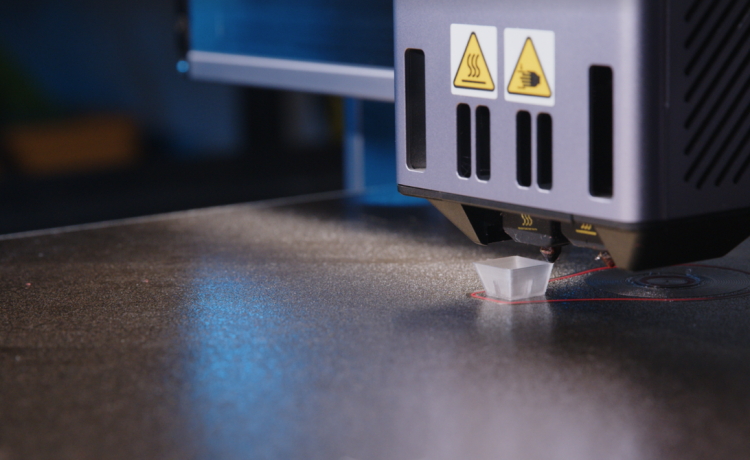
To the casual observer, a Fused Deposition Modeling (3D printer) appears to be a machine that simply melts plastic and draws layers. However, the component responsible for the precise measurement, feeding, melting, and deposition of material—the engine of the entire process—is the extruder. Far more than just a nozzle, the extruder assembly is a highly calibrated subsystem composed of mechanical and thermal components that must work in perfect synchronization to transform solid 3D printer filament into microscopic, flowing plastic lines. Understanding the principles and function of this complex head is the definitive step toward diagnosing print failures, calibrating a machine for optimal performance, and unlocking the full potential of additive manufacturing.
The Dual Architecture of the Extrusion System
The entire extruder assembly can be conceptually divided into two distinct but interdependent sections: the Cold End and the Hot End.
The Critical Function of the Cold End
The Cold End is the mechanical component responsible for gripping the solid 3D printer filament and pushing it forward. Its core function is to maintain constant, precise pressure to feed the filament into the melting zone at a measured volumetric rate.
Key Components of the Cold End:
- Drive Gear and Motor: This assembly provides the power. A stepper motor turns a specialized gear (often hobbed or toothed) that bites into the soft 3D printer filament. The motor’s rotation rate is precisely controlled by the printer’s electronics (E-steps), ensuring that a specific length of filament is fed for every movement the machine makes.
- Idler Bearing and Tensioner: A smooth bearing or wheel is pressed against the filament opposite the drive gear. The tensioner mechanism allows the user to adjust the pressure, ensuring the drive gear maintains adequate grip without crushing the filament, which could lead to inconsistent diameter and flow.
Understanding the Two Main Extruder Architectures
The location of the Cold End relative to the Hot End defines the two primary extruder architectures used in FDM 3D printers, each impacting print speed, quality, and material compatibility:
- Direct Drive: In this setup, the Cold End motor assembly is mounted directly above the Hot End. This offers the shortest possible filament path, resulting in high responsiveness, precise control over retraction (pulling filament back to prevent stringing), and the ability to easily print flexible 3D printer filaments, which require maximum support to prevent buckling.
- Bowden: In this architecture, the Cold End motor is mounted on the 3D printer’s frame, separate from the print head. The filament travels through a long, flexible PTFE tube (the Bowden tube) to reach the Hot End. This design significantly reduces the mass carried by the moving print head, allowing for much higher travel speeds and accelerations, resulting in faster print times. The trade-off is reduced retraction precision and difficulty printing soft, flexible materials.
Mastering the Hot End: The Melting Chamber
The Hot End is the thermal component responsible for rapidly converting the solid plastic supplied by the Cold End into a viscous fluid ready for deposition. It is a finely tuned thermal gradient system.
Key Components of the Hot End:
- Heat Sink and Heat Break: This is the most critical thermal barrier. The Heat Break is a small, usually metal, tube connecting the cold and hot sections. Its function is to rapidly transition the temperature gradient from room temperature (at the Cold End) to the melting temperature (at the Hot End) over a very short distance. The Heat Sink actively draws heat away from the Heat Break to prevent heat creep—the undesirable condition where heat travels up the filament path, causing the 3D printer filament to soften prematurely and jam the system.
- Heater Block: This aluminum or ceramic block holds the heater cartridge, which provides the electrical energy to melt the filament. It is the component that defines the core operating temperature of the printing material.
- Thermistor: A tiny electronic component embedded in the Heater Block, the thermistor provides constant, precise feedback on the actual temperature to the 3D printer’s control board. This constant feedback loop is essential for maintaining the stable temperature required for consistent material flow.
- Nozzle: The final stage of the extruder, the nozzle acts as the aperture through which the molten plastic is shaped and deposited onto the build surface. The nozzle’s diameter (typically ) dictates the width and height of the extruded bead and, consequently, the part resolution. Different materials, particularly abrasive composites containing carbon fiber or glass, require hardened steel or ruby-tipped nozzles.
Extruder Performance: Flow Rate and Calibration
The overall performance of the 3D printer is often limited by the extruder’s ability to melt and push material consistently, known as its volumetric flow rate, measured in .
The Importance of E-Step Calibration
E-steps (Extruder steps per millimeter) calibration is a crucial maintenance task. It ensures that when the control board commands the Cold End motor to feed of 3D printer filament, the motor physically moves exactly of filament. Inaccurate E-steps lead to systematic under- or over-extrusion, fundamentally undermining the structural integrity and dimensional accuracy of the printed part. For high-performance printing, this calibration should be checked regularly, especially after any modifications to the Cold End.
The Thermal Limitation of Speed
The extruder dictates the maximum speed at which a part can be printed. While the printer’s motion system may be capable of moving the print head very quickly, the limiting factor is often the Hot End’s ability to melt the 3D printer filament fast enough. Pushing the print speed too high without adjusting the nozzle temperature or upgrading the melt zone volume will result in under-extrusion, as the Cold End pushes the filament faster than the Hot End can process it. The relationship between speed, temperature, and material flow is the most complex thermal challenge the 3D printer must manage.
Conclusion
The extruder is indisputably the heart of the FDM 3D printer, functioning as a meticulously engineered bridge between the digital model and the physical reality. It is a two-part system—the Cold End pushing the solid 3D printer filament, and the Hot End precisely melting and metering the liquid plastic. Mastery of the extruder assembly—from understanding the trade-offs of the Bowden versus Direct Drive architecture to calibrating E-steps and controlling the thermal integrity of the Heat Break—is essential. By treating the extruder not as a simple accessory but as a critical, high-precision subsystem, users can consistently achieve high-quality results, optimizing their prints for speed, strength, and aesthetic finish.